Archive
Statomics the class: Coming this fall
The Department of Mathematics and Statistics of the University of Ottawa offers the following special topics class in the fall of 2009.
Statistical Genomics: MAT 4376/5313 (MATH 6507)
Coherent frequentism
D. R. Bickel, “Coherent frequentism,” Technical Report, Ottawa Institute of Systems Biology, arXiv.org:0907.0139 (2009). Full preprint
Postdoctoral training in Bayesian genomics

Scientific breakthroughs from genome-sequencing projects brought the realization that reliable interpretation of the resulting information makes unprecedented demands for innovations in statistical methodology and its application to biological systems. This unique opportunity drives research at the Statistical Inference and Computation in Genomics Laboratory of the Ottawa Institute of Systems Biology. The Statomics Lab (http://www.statomics.com) seeks a postdoctoral fellow who will collaboratively develop and apply Bayesian methods of statistical inference to attack current problems in analyzing transcriptomics, proteomics, metabolomics, lipidomics, and/or genome-wide association data.
A thorough knowledge of Bayesian theory is essential, as is the ability to quickly develop reliable software for approximating posterior distributions using complex models. Strong initiative, excellent communication skills, and reception of a PhD or equivalent doctorate in biostatistics, statistics, or a closely related field within the four years prior to the start date are also absolutely necessary. The following qualities are desirable but not required: expertise in one or more methods of frequentist inference; a working knowledge of biology; familiarly with R, S-PLUS, Mathematica, C, Fortran, and/or LaTeX; experience in a UNIX or Linux environment.
To apply, send a PDF CV that has contact information of three references to dbickel0@uottawa.ca (without the zero), with “Bayesian Genomics” and the year of your graduation or anticipated graduation in the subject field of the message. In the message body, concisely present evidence that you meet each requirement for the position and describe your most significant papers and software packages with summaries of how you contributed to them. All applicants are thanked in advance; only those selected for further consideration will receive a response.
Gene network reconstruction from transcriptional dynamics
D. R. Bickel, Z. Montazeri, P.-C. Hsieh, M. Beatty, S. J. Lawit, and N. J. Bate, “Gene network reconstruction from transcriptional dynamics under kinetic model uncertainty: A case for the second derivative,” Bioinformatics 25, 772-779 (2009).
Statistics abused
On Probability As a Basis For Action (PDF) is recommended as a corrective for over-emphasizing p-values at the expense of estimated effect sizes.
Fold change estimation versus hypothesis testing
D. R. Bickel and C. M. Yanofsky, “Validation of differential gene expression algorithms: Application comparing fold change estimation to hypothesis testing,” Preprint, Ottawa Institute of Systems Biology, COBRA Preprint Series, Article 50, available at tinyurl.com/bw9jod (2009).
Strength of evidence for composite hypotheses
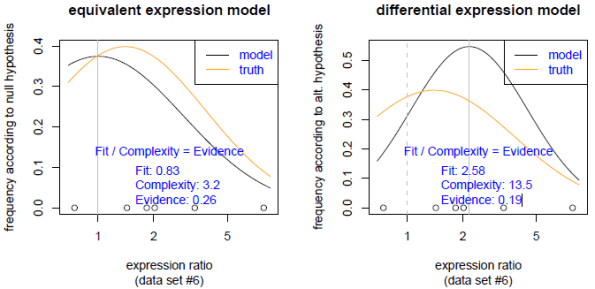
D. R. Bickel, “The strength of statistical evidence for composite hypotheses with an application to multiple comparisons,” Preprint, Ottawa Institute of Systems Biology, COBRA Preprint Series, Article 49, available at tinyurl.com/7yaysp (2008).
Preprint servers for statistical bioinformatics
The COBRA Preprint Series was selected for the dissemination of the Statomics Lab’s working papers because it offers more flexibility than the other main services for statistical genomics preprints:
- Unlike arXiv, COBRA accepts PDF files generated by LaTeX. Preparing LaTeX source code specifically for a preprint server can require large time investments.
- Unlike Nature Precedings, COBRA does not require authors to irrevocably license their work for commercial reuse. Such licenses might conflict with the interests of some commercial publishers since they allow competitors to distribute the preprints for profit.
Information-theoretic analysis of -omics data
To view the slides and plots of the lecture “Information-theoretic analysis of -omics data,” delivered 17 November 2008 in BIO 5106 (BIOL 5506) Bioinformatics, follow this link and select “Download.” The slides are also available separately.
Corrected 16 January 2009.
License: Attribution Non-commercial.
Postdoctoral training in model selection & applications

Scientific breakthroughs from genome-sequencing projects brought the realization that reliable interpretation of the resulting information makes unprecedented demands for advances in statistical methodology. As the complexity of genomic data sets drives innovative research in statistics, the Statistical Inference and Computation in Genomics (Statomics) Lab of the Ottawa Institute of Systems Biology attacks inferential challenges of importance to human health. The lab seeks a postdoctoral researcher who will collaboratively develop and apply statistical methods of model selection to solve current problems in analyzing transcriptomics, proteomics, metabolomics, lipidomics, and/or SNP-chip data.
A thorough knowledge of statistical theory is essential, as is the demonstrated ability to quickly and accurately implement complex statistical methods in software. Strong initiative, excellent communication skills, and reception of a PhD or equivalent doctorate in biostatistics, statistics, or a closely related field within the four years prior to the start date are also absolutely necessary. The following qualities are desirable but not required: expertise in one or more methods of frequentist model selection; knowledge of biology; familiarly with R, S-PLUS, C, Fortran, and/or LaTeX; experience in a UNIX or Linux environment.
To apply, send a PDF CV that has contact information of three references to dbickel0@uottawa.ca (without the zero), with “model selection & applications” and the year of your graduation or anticipated graduation in the subject field of the message. In the message body, concisely present evidence that you meet each requirement for the position and describe your most significant papers and software packages with summaries of how you contributed to them. All applicants are thanked in advance; only those selected for further consideration will receive a response.
 David Bickel, statistician
You must be logged in to post a comment.